










This guide contains all the information you need to know to get your new gear up and running, along with handy links to any available accessories and other relevant information. If you require technical support, please contact our support team for assistance. Contact details are contained within this guide.
- Do not use this battery for cranking applications.
- Do not submerge the battery in water.
- Do not short circuit the battery terminals.
- Do not puncture, impact or drop the battery.
- Do not disassemble the battery. Opening the case may cause electric shock or fire and will void your warranty.
- Do not expose the battery to fire, sparks, high voltage or temperatures in excess of those stipulated in the specifications table of this manual.
- Do not connect more than four (4) of these batteries together in series or four (4) in parallel. Ensure that connections are made correctly as per the “Usage and Storage” section of this manual. Do not connect this battery to batteries with different chemistries.
- Before storage, charge the battery to at least 40-50% capacity, keeping in mind the self-discharge rate of 3% per month. Do not store the battery at a voltage lower than 11.5V.
- You must charge the battery immediately if it is found to have dropped below 10V. Ignoring this may cause permanent damage to the battery cells.
- Endeavour to keep the battery above 20% SOC where possible.
- Observe the limitations of this battery as stipulated in the specifications table of this manual, paying particular attention to maximum charge and discharge currents.
- To charge the battery, you must use a charger with a specific charging profile for lithium batteries.
- Your warranty may be reduced or voided if you use an unsuitable charger.
- If the battery emits any unusual smells, appears to be atypically hot, shows signs of distortion or displays any other abnormality during operation or storage, discontinue use immediately and contact Hardkorr for assistance.
- The battery should not be used by persons (including children) with reduced physical, sensory or mental capabilities, or lack of experience and knowledge, unless they are supervised or have been instructed on how to use the appliance by a person responsible for their safety.
- Cable and fuse sizes are specified by various codes and standards which depend on the type of vehicle the battery is installed into.
- Selecting the wrong cable or fuse size could result in harm to the installer or user and/or damage to the battery or other equipment installed in the system.
- The installer is responsible for ensuring that the correct cable and fuse sizes are used during installation.
BLACK SERIES LITHIUM BATTERY OWNER’S GUIDE
The Black Series batteries are smaller, lighter, and are packed with more features than you can shake a stick at, all aimed at making your 12V camping experience easier! Not only will you be able to fit your setup into tighter spaces in your vehicle, but getting the battery in and out will be less of a hassle. Need to check up on your battery before, during or after a trip? No worries, the integrated wireless monitoring capability allows for complete oversight of your battery's health from inside the vehicle, or across the campsite.
PRODUCT OVERVIEW
Meet the next generation of reliable off-grid power: our Black Series 100Ah Lithium (LiFePO₄) Deep Cycle Battery. Designed for serious 4WDers, campers and tourers, this battery delivers exceptional performance, durability, and efficiency, ensuring your setup never runs out of 12V power when you need it most. Built to fit seamlessly into standard Group 24 (NS70) battery trays and boxes, it’s the perfect drop-in replacement for traditional AGM units.
Each Black Series battery is produced using state-of-the-art robotic assembly and verified through a strict quality control process, including serialised tracking and comprehensive pre-shipment cycle testing. Our confidence in quality is backed by a 5-year* Australian warranty.
SETUP & STORAGE
INSTALLATION
- Ensure that the area in which you will be performing installation of the battery is dry. Secure the battery firmly to the mounting surface, ensuring that no movement is possible even under significant force.
- You may install the battery in any orientation, including upside-down.
- Ensure that your proposed installation location will not cause the battery to be exposed to temperatures in excess of the maximums stipulated in the specifications table of this manual. If you believe heat may be an issue, you may consider making use of mechanical ventilation such as fans.
- Ensure you do not mount the battery in a way that could cause the terminals to come into contact with any metal surface or object. This is to avoid the possibility of short-circuiting the terminals. If you are intending to remove the battery from its installed location periodically, ensure there is a clear pathway free of metal surfaces and objects.
- Do not install the battery in a wet area such as boat decks, open ute trays or chassis mounts.
- Do not install the battery in a compartment dedicated to gas storage.
CONNECTION
We recommend that no more than four cable lugs be connected directly to a battery terminal. If you do have more than 4 lugs, you should use a fuse block and negative busbar instead.
Ensure the battery terminals are clean before connecting any cable lugs to them. Stack cable lugs on the battery terminals in order from heaviest draw (thickest cables) to lightest draw (thinnest cables). Lugs connected to the thickest cables should be positioned at the bottom and the thinnest at the top.
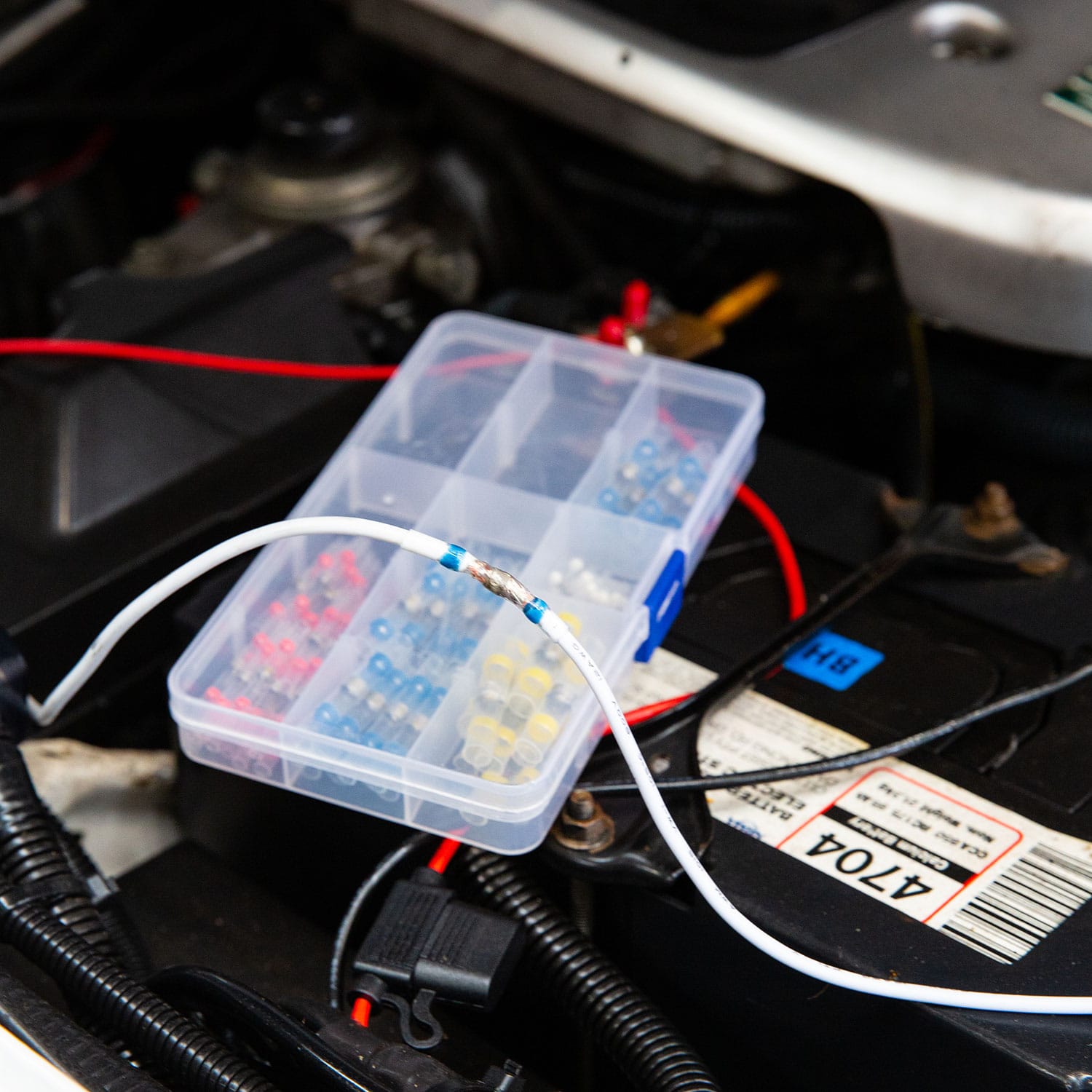
Where possible, make use of insulating terminal boots and lug protectors. Ensure all termination lugs are well crimped (not soldered) and protected. Always use the spring washers provided for the battery terminal bolts. This ensures sufficient pressure is applied to the cable lugs for secure connection without having to over-tighten the bolts. Stack the spring washer on top of the cable lugs, not underneath.
STORAGE, SHIPPING & DISPOSAL
Ensure that the battery is stored in a dry, clean, shaded and well-ventilated environment, at a temperature range that does not exceed the maximum storage temperature stipulated in the specifications table in this manual.
Where possible, endeavour to store the battery at around 40-50% state of charge.
At no time should the voltage of the stored battery be allowed to drop below 11.5V.
Be aware that these batteries will self-discharge at a rate of about 3% per month. We recommend the state of charge is checked regularly and topped up if necessary.
If shipping the battery between locations, please be aware that lithium is classified as Class 9 Dangerous Goods. Please ensure you comply with local, national and international (if applicable) regulations for transportation of these goods.
CHARGING YOUR BATTERY
Lithium batteries need to be charged a little differently to other batteries, to ensure they live a long life and provide maximum capacity. There are several charging devices you can utilise, but whichever device you choose, it must have a lithium charge profile. Suitable devices include DC-DC chargers, solar panels (with regulator) and AC (mains power) chargers. It is recommended that the charging current should be 30% or less of your battery capacity. You can charge at higher currents, but 30% is recommended for optimum battery longevity.
CHARGING METHOD: DC-DC CHARGER
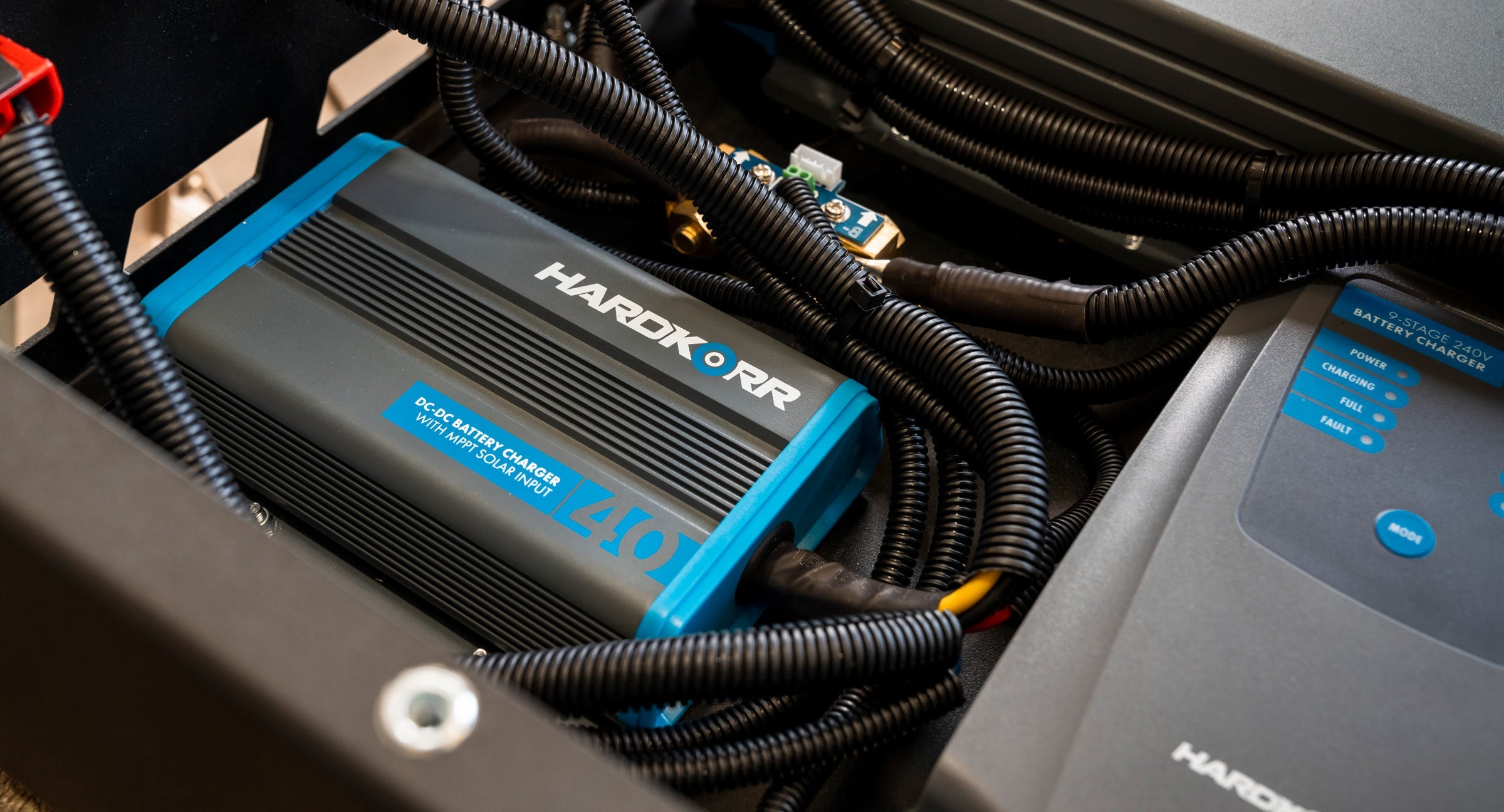
DC-DC chargers allow you to charge your auxiliary lithium battery from your vehicle’s alternator.
You generally cannot charge a lithium battery directly from a vehicle alternator, because lithium batteries have a very high maximum charge current compared to lead-acid batteries. With nothing to intermediate between the alternator and battery, the battery will draw its maximum charge current from the alternator, which can lead to the alternator overheating and burning out.
A DC-DC charger will act to moderate the flow of current, protecting your alternator from overheating. In addition, they have a multi-stage charging algorithm which will ensure your battery is optimally charged and its service life is maximised. Some DC-DC chargers also include a second input allowing you to connect a solar panel. The charger must be set to the lithium charge setting prior to use. Failure to do so may cause damage to the battery and void the warranty.
CHARGING METHOD: SOLAR POWER
12V solar panels harness the energy of the sun to charge your battery. There are many solar panel options on the market, but they can be split into two main categories: fixed and portable.
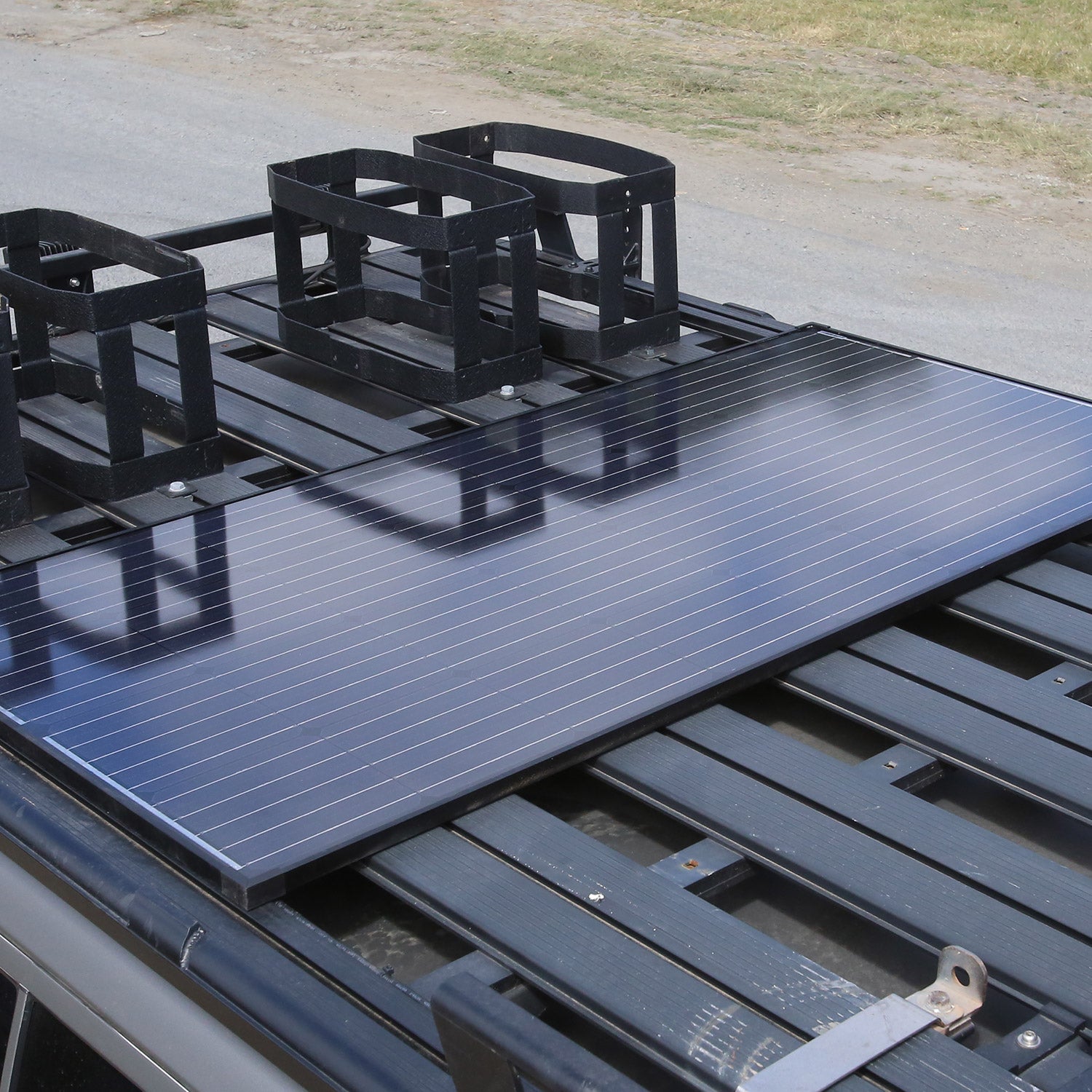
Fixed solar panels usually have a rigid metal frame. They are designed to be permanently fixed to your vehicle and connected to a regulator or DC-DC charger mounted inside. They are great for charging your vehicle while on the go without consuming current from your alternator.
Portable solar panels (solar blankets, solar mats etc.) are designed to be set up while the vehicle is stationary, such as when you’re at camp. They are usually connected to the battery via a portable regulator.
Either type of solar panel is fine for charging these lithium batteries, but as stated previously it is important to ensure that your regulator has a lithium charge profile to maximise your battery’s service life.
CHARGING METHOD: 240V AC CHARGER
If you’re charging up your batteries at home before or after a trip, or if you’re at a powered camp site, you can also use an AC (mains power) battery charger. Mains battery chargers are available as portable devices or can be built into your 12V system. Again, you should make sure that the AC charger you wish to use contains a lithium charge profile.
Before connecting to the battery, please make sure to have read the instruction manual of the charger used and ensure you have a thorough understanding of the unit.
DO NOT use a charge profile with a “Pulse” or “Equalisation” stage. This will damage the battery and void the warranty. DO NOT charge your battery directly from an alternator or via VSR.
WIRELESS CONNECTIVITY
The Black Series batteries are one of many Hardkorr products that are compatible with the all-in-one HK App. The HK App offers a range of useful features to ensure you have all the information you need at your fingertips:
- State of charge
- Nominal voltage and capacity
- Live current draw and battery voltage
- Status indicators (standby, discharging, charging)
- Time to empty / Time to full
- Total charge cycles
- Temperature monitoring
- Detailed cell information
Connect to multiple batteries, group them in groups (parallel / series/ mixed), received unbalanced group alerts.
SPECIFICATIONS
| Specification | 100Ah | 150Ah | 314Ah |
|---|---|---|---|
| Nominal voltage | 12.8V | 12.8V | 12.8V |
| Capacity | 100Ah | 150Ah | 314Ah |
| Cycles | 5000 (80% DoD) | 5000 (80% DoD) | 5000 (80% DoD) |
| Self-discharge | <3% per month | <3% per month | <3% per month |
| Charge voltage | 14.4V ± 0.2V | 14.4V ± 0.2V | 14.4V ± 0.2V |
| Max. charge current | 100A | 150A | 100A |
| Max. discharge current (continuous) | 100A | 200A | 150A |
| Discharge cut-off voltage | 10.0V | 10.0V | 10.0V |
| Charge temperature | 0°C ~ 60°C | 0°C ~ 60°C | 0°C ~ 60°C |
| Discharge temperature | -20°C ~ 60°C | -20°C ~ 60°C | -20°C ~ 60°C |
| Storage temperature | -10°C ~ 45°C | -10°C ~ 45°C | -10°C ~ 45°C |
| Terminal size | M8 | M8 | M8 |
| Max. configuration | 4 in series / 4 in parallel | 4 in series / 4 in parallel | 4 in series / 4 in parallel |
| Dimensions | 260 x 168 x 209 mm | 307 x 169 x 208 mm | 345 x 190 x 245 mm |
| Weight | 9.7kg | 13.5kg | 25.45kg |
| Certifications | UN 38.3, UL1973, ISO 9001, ISO 14001, IEC 62619-2:2022 | UN38.3, UL1973, IEC62619, CE, RoHS | UN38.3, UL1973, IEC62619, CE, RoHS |